Falling in Love with French Viognier Again & Finding a Malbec with Nobility

Falling in Love with French Viognier Pic 3

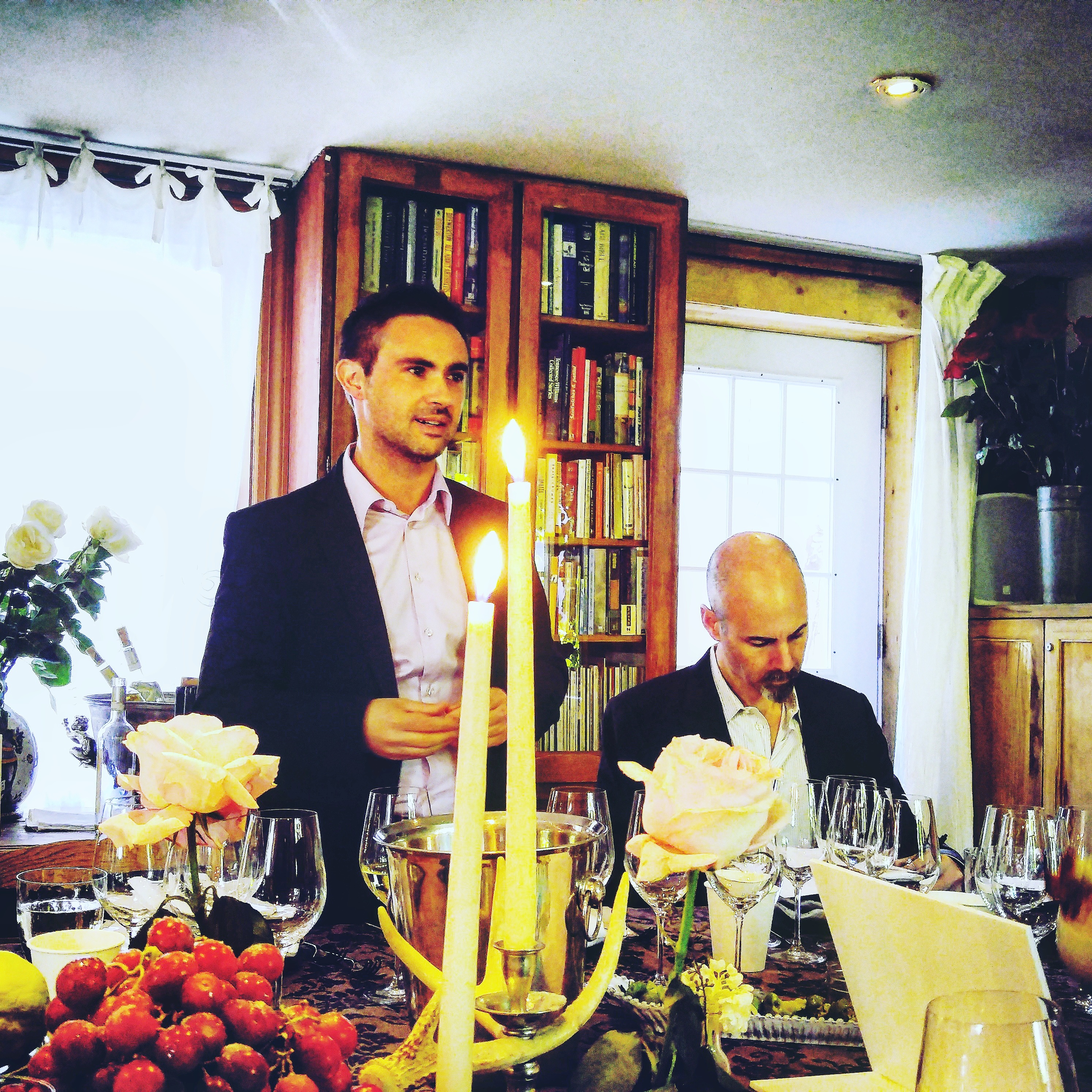
Loud laughter, an electric energy and lots of smiles filled our table of seven people for an intimate dinner with Alain Dominique Perrin, the owner of Domaine de Lagrézette, at Le Bernardin. We were there to meet Mr. Perrin with his Managing Director & Enologist, Claude Boudamani, and to taste a vertical of their Viognier wines on October 15th. Happily we were able to taste their Le Pigeonnier Rosé and Malbec red wine as well.

I had been to Le Bernardin for wine dinners in the past but I had never felt as at home. Simply put – I had a blast that night. It was a great evening with colorful stories that were fleshed out with the incredible life that Alain Dominique Perrin has lived. He has the ability to make you feel immediately at ease when you initially approach him. That evening, he proceeded to take us on a journey of his unique life that was filled with so much beauty – antiques, the restoration of Château Lagrézette, design and art.

Alain Dominique Perrin

Mr. Perrin is famous for helping to turn the fortunes of Cartier around, and also for leading the Richemont group, which is considered one of the largest luxury goods groups in the world. His initial dream was to buy a grand château with a long history and breathtaking view – after looking at over 100 properties, he settled on Lagrézette, in Cahors located in Southwest, France.

Château Lagrézette
Falling in Love with French Viognier Pic 2

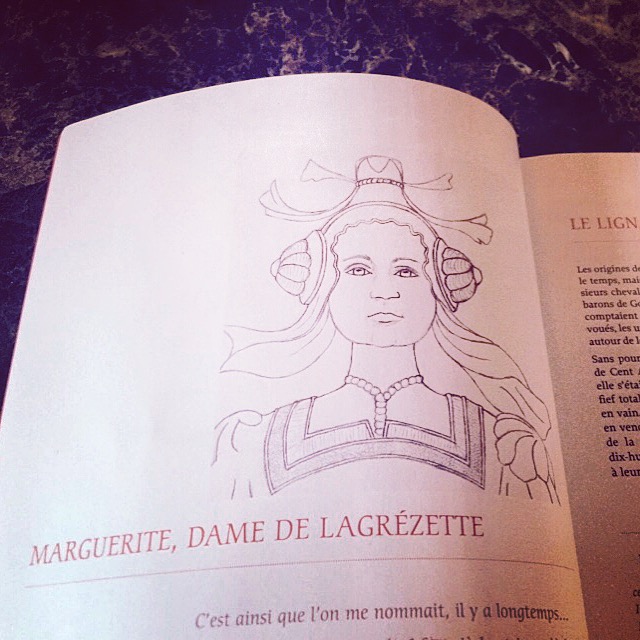
His majestic home is filled with many carvings that came with this grand 500 year old estate, but the one that caught my eye when I was looking through a book that contained the Château Lagrézette sculptures, coats of arms and decorations, was the carving of Marguerite, Dame de Lagrézette (Pictured above). It is said that though men built Château Lagrézette it was women who had given the château its soul. And this place is Alain Dominique Perrin’s home, a home in which his children, grandchildren and dear friends make beautiful memories.

The purchase of this property has changed his life in many ways as it included the rights to the plantation of vines. Through time he has acquired other vineyards in the Cahors area with an attitude to always strive to be better by surrounding himself with very talented people. And by surrounding himself with top wine experts, he has discovered through time that there were great variations in the soil within the same vineyards – and so that is why he has varieties other than Malbec planted, such as Viognier.

Viognier

Viognier is a white grape variety that is capable of making intensely aromatic wines with a rich body and moderate to sometimes low acidity. This currently widely planted vine was almost unheard of not that long ago. Viognier has not only taken off in certain areas of California and Australia, but there are also good examples in South Africa and New Zealand. It is used as a blending grape, for co-fermentation or as a single variety. But it is a tricky variety in the vineyards and winery – it can quickly become lifeless, and span the range between overtly perfume-y to a bland white.

French Viognier

I first fell in love with Viognier through the wines of Condrieu. The Rhône Valley, France, is where Viognier has legitimized itself with traditional fine wine drinkers. But through time these wines have seemed almost a little too reserved for such an expressive variety. Conversely, the New World versions are certainly intoxicating with pronounced aromatic intensity but I commonly miss the sense of place.

The 2011, 2012 and 2014 Domaine de Lagrézette Mas des Merveilles and the 2014 Le Pigeonnier “White Vision” Viognier wines I tasted during our dinner were finally the Viognier wines I was looking for – they were the balanced expression of place and variety. And they were from Cahors – an area known for their big, robust Malbec red wines! How could that be possible?!

Malbec

That leads me to the biggest surprise of the night – the 2011 Le Pigeonnier Malbec.
I have to admit that even though I love Malbec wines, I honestly never saw the grape on the same level as its Bordeaux brothers: Cabernet Sauvignon, Merlot or even Cabernet Franc. I have had very good Malbec wines from Argentina and Cahors but I haven’t had an outstanding 100% Malbec wine. Also, through my wine career I have heard many times from top Bordeaux owners, as well as Managing Directors, that Malbec was not considered a noble variety and hence why many top châteaux in Bordeaux no longer have it planted in their vineyards.

I remember sitting in a classroom in Bordeaux a few years ago with Denis Dubourdieu, a famous Professor of Oenology. He said that Malbec was a variety for peasants. And even though I did not fully agree with him at the time, I did think that Malbec had a limited potential.

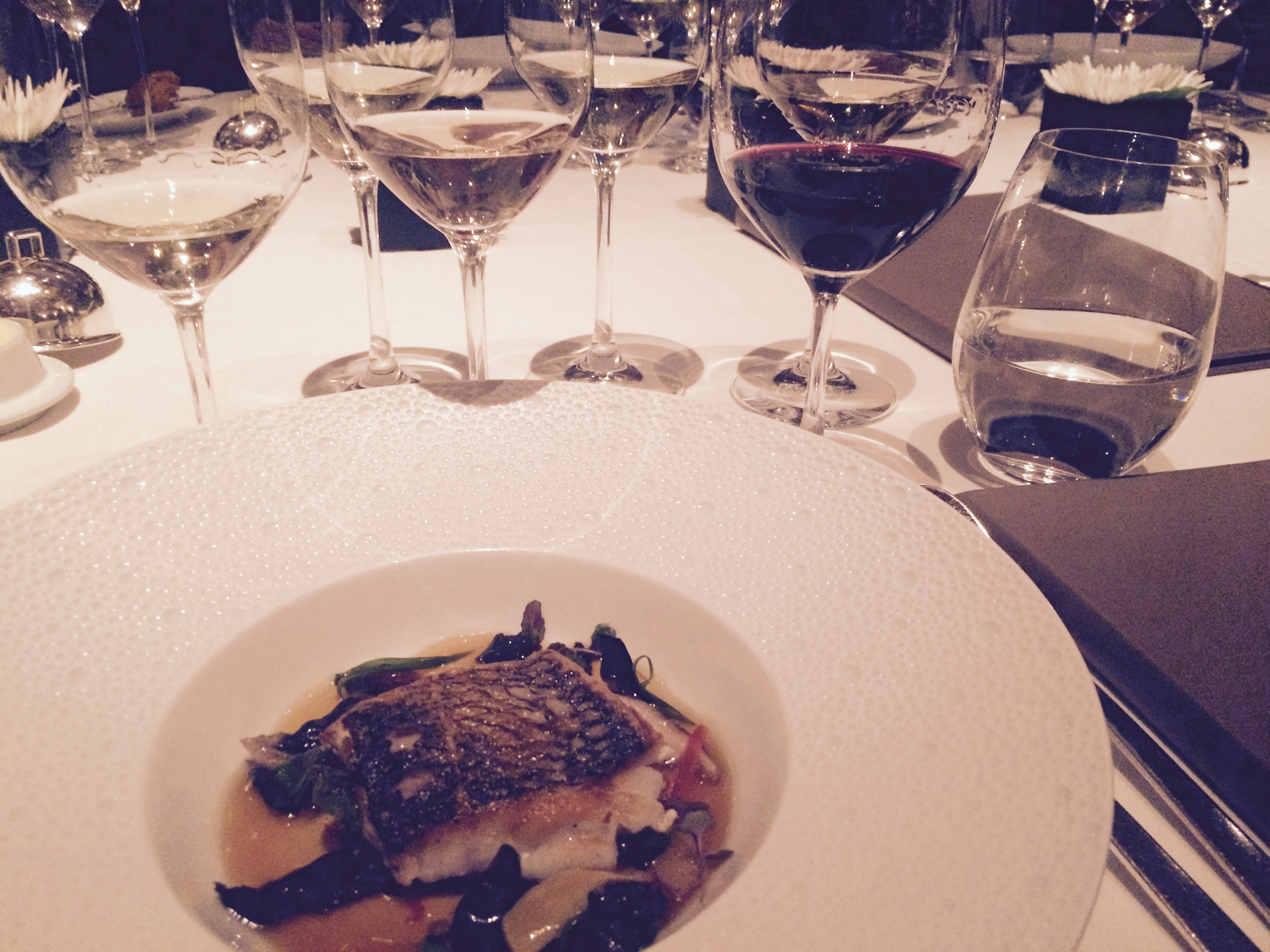
Well, Mr. Perrin said that he knew that Malbec could become a great wine, and Cahors a great wine making area – and he proved it that night. The Le Pigeonnier Malbec really impressed me. It was intensely concentrated while staying incredibly elegant. And it was perfectly paired with a crispy black bass with wood ears and a black truffle “hot and sour pot au feu” (Pictured at the top of this post).

Why was it a perfect pairing? Because it showed that this richly ripe Malbec had the great structure and balance to go with such a refined fish dish. It had power and finesse. And in that moment of having this unorthodox pairing I realized that Malbec was, indeed, a noble variety.

A Passion for Mixing the Ancient & Modern Worlds

Mr. Perrin showed us that night that the ancient and modern worlds could live in perfect harmony. It was only fitting that we had this incredible tasting at Le Bernardin – in part because of Mr. Perrin’s long relationship with the owners Maguy Le Coze and Chef Eric Ripert. It was also fitting because Le Bernardin is a great example of combining traditional French cooking techniques with more modern styles of creating complex broths with layers of aromatics in the dishes that give a healthier, elevated experience.

When I walked out the door of Le Bernardin that night, after my dinner with Alain Dominique Perrin, I was walking on cloud nine so to speak. The conservations all around were uplifting, exciting and fun – the food was outstanding and the wines enlightening. Mr. Perrin seems to have a way of bringing everything to a level of greatness. He not only shoots for the stars but he eventually reaches them.

********************************************************
-2014 Le Pigeonnier Rosé from Magnum :
100% Malbec
Case Production : 250 cases (6-bottle case)
7 acres (2.7 hectares) vineyard directly adjacent to the grounds of Château Lagrézette. Enclosed by ancient stone walls, the vineyard contains a 17th century dovecote, which gives the wine its name.

A pretty pink color with real restraint on the nose that has a distinct minerality with lovely floral notes and a round body; juicy peach flavor on the palate.

The 2011, 2012 & 2014 Mas des Merveilles wines have the following production information:
100% Viognier
Case Production : 1200 cases (12-bottle case)
Côte du Lot Rocamadour IGP
Clay and limestone vineyards around 25 acres (10 hectares) in the medieval town of Rocamadour (Lot).
-2011 Mas des Merveilles Viognier :
The 2011 was the most linear in shape with a more mineral than fruit quality compared to the other vintages. A hint of dried flowers rolled around in my head on the heady finish.

-2012 Mas des Merveilles Viognier :
Lots of pristine apricot and tangerine flesh-y aromatics and flavors with a textural complexity with the minerality more in the background.

-2014 Mas des Merveilles Viognier :
(They did not make a 2013 because the quality was not up to their standards)
Orange blossom and jasmine notes with a touch of wet stones and refreshing acidity.

-2014 Le Pigeonnier White Vision from Magnum :
100% Viognier
Case Production: 300 cases (6-bottle wooden case)
2.5 acres (6 hectares) single-vineyard located in the Côte du Lot.

The vines are only eleven years of age but yields are extremely low, around 25 hl/ha.

Exotic spice with layers of rose, stone fruits and smoky notes that were intoxicating with a great weight perfectly balanced with lively flavors that have a long, flavorful finish.

-2011 Le Pigeonnier Red Malbec from Magnum:
100% Malbec
Case Production: Around 1070 cases (6-bottle wooden case)
Extraordinarily low yields around 15 to 20 hl/ha

Deep ruby color with a distinctive purple hue. A simply stunning Malbec that was powerful yet elegant, full bodied yet focused. An intense concentration of violets, plummy fruit and a hint of coffee that is carried along the ripe yet structured body that somehow pulls off a long finish that had lots of finesse.

Posted in Dame Wine | Tagged , , , | 2 Comments

Focusing on the Science of Wine: Does it take away the Magic?

AAA

One of the best things about the wine world is the diversity of people – not only due to different ancestry or origin, but in some cases, the diversity involves producers coming from other disciplines. But what happens when you have a producer with the background and mentality of an engineer who has a mission to improve winemaking as we know it? Does it take away the magic? I know this is a current debate among many wine lovers – some feeling we should focus on place and passion. But maybe the science of wine helps us to understand the magic better?

These thoughts crossed my mind as I tasted the 2009 Domaine Lois Louise Santa Cruz Mountains AVA samples by Clos de la Tech.

This is a crazy time of year for the wine trade and wine writers in the New York City area. They refer to it as O.N.D. (October, November and December). I usually do not ask wineries to send me samples during this time of year since there are so many wine trade tastings and dinners, but I was curious about Clos de la Tech and hence I googled this producer. I found several videos by the owner, T.J. Rodgers. It intrigued me how Dr. Rodgers has combined his engineer mentality (find a problem and fix it) with his passion for Burgundy wines.

T.J. Rodgers is the founder, president, CEO, and a director of Cypress Semiconductor Corporation. He is a big deal in Silicon Valley.

Honestly, that is not what interested me. What interested me was his winery videos showing him as a man that loved to fix problems, a man that loved wine and ultimately has combined these two passions together.

I cannot go into everything he is doing, but one example of the systems and procedures he is using to help improve winemaking is the TJ Experimental Fermenter. It is a tank that can be monitored and controlled (must and cap temperature, measure brix, introduce oxygen at the right moment with pumpovers, etc.) from one central control station. Click on the YouTube video below if you are curious to hear him explain it in a little bit more detail.

I think it is very easy to get so caught up in the idea of who T.J. Rodgers is that we don’t even consider that he could be potentially helping other struggling producers with his current experiments and inventions. I was fascinated by the videos of him explaining what improvements he is making in the winery and vineyards because I saw a man who was an engineer in his very being – similar to every other engineer I have known. Good engineers do not change something just for the sake of changing it – they see that there is a problem and they have it in their DNA to try to improve it.

As a wife of an engineer, I understand that mentality well!

But why do improvements by understanding the process sometimes get translated into taking away the magic?

It is interesting that T.J. Rodgers loves the wines of Burgundy – I would say that Burgundy is considered to be one of the most magical places in the wine world. Also, those who drink Burgundy, especially Pinot Noir, would say it is one of the most inconsistent wine regions in the world.

When I think of my own travels to Burgundy and visiting small producers, I loved how many would say that they had no idea why things worked how they worked – they just trusted what their parents and grandparents did before them. And when an exceptional wine is made in those sorts of “mysterious” ways, it is magic – there is no formula to figure it out.

Conversely, why is a formula that helps to not “mess up” what Mother Nature has already given us a bad thing? Aren’t the sometimes radical climatic conditions magic enough? Don’t we, as consumers, as well as producers, want some sort of minimum level of quality?

There are the wild wine nerd wines (and I am a wine nerd) that will always be given some leniency by their small niche following. But the wine drinking world in general expects more consistency since quality and consistency around the world has greatly improved.

Dr. Rodgers talks about honoring the heritage of the Burgundians: using French clones, native yeasts and gravity flow, but he has also invented a fermenting system that has a greater capacity to monitor and control temperature. He has even donated several experimental tanks to UC Davis. It could potentially not only help other producers to guarantee a higher quality of wine but it could lower costs by its efficient design.

Since wines are an agricultural crop I think there will always be a magic to the process -because there are many things about this grand planet we do not fully understand.

There is a balance in making sure wine making is not so much of a mystery and yet still stays somewhat magical – that way the winemakers and wine drinkers alike can have some assurance of having a nice bottle of wine, and hence, we can enjoy the magic that much more.

**************************************************************

2009 Clos de la Tech, Lois Louise Estate, Santa Cruz Mountains AVA, California :
I tried two bottles and both were consistent in their profiles and quality levels. Each one was hand numbered with one being 3057 of 7058 and the other 3098 of 7058. A big wine that is generous at a relatively youthful age but I would decant it for a couple of hours since I thought it showed a lot more through time. It has a great muscular structure that would be typical of Nuits-Saint-Georges wines in Burgundy, but balanced with a rich, fruit forward quality that also reminds me of Vosne-Romanée. A deep ruby color that has notes of black cherry, anise, tobacco leaf, hints of red clay and a powerful, sustained length.

The wine is named after T.J. Rodgers’ mother, Lois Louise, whose picture graces the label. The picture was taken after World War II ended and she was just released from the army.

Also, his wife, Valeta Massey, is also co-owner and assistant winemaker. Their Domaine Valeta wine is named after her, and their Domaine du Docteur Rodgers is named after T.J. Rodgers. As they always say, behind every great man there’s a great woman – in this case there are two.

Posted in Dame Wine | Tagged , , | Leave a comment

Bordeaux Wines: Everyone is Invited to the Party

Bordeaux Drinking and having fun

I have been to Bordeaux a few times but the one time that stands out in my mind was during the Bordeaux Fête le Vin in 2010, which was taking place at the same time as the Masters of Wine Symposium that had chosen Bordeaux as their host city. It was a great time to show off a “nicer”, more tourist friendly, city as Bordeaux was known for being an unsavory town at one time. But now they have a new tram, an upgraded boardwalk by the river, and brighter lighting at night. The Fête le Vin, which takes place every two years really shows the spirit of the Bordelais – they are serious about making wine but playful when drinking it. It was an incredible experience walking around tasting many of their vinous offerings while listening to music, seeing people wearing fun hats with laughter filling the streets.

Bordeaux Jazz Band

Perception

Currently, Bordeaux is trying to improve their image.

Their image problem reminds me of a past teaching from a renegade American Buddhist monk. I did not agree with many of this particular monk’s unorthodox practices, but there are a couple of lessons I have carried with me. The one that relates to Bordeaux is the “Pen Lesson”. We may look at a pen and see it as a writing instrument, but a dog may see it as a chew toy: two completely different perceptions for the same item.

We deal with problems of perception every day. How many times has someone made a wrong assumption about you? Typically they made this wrong assumption based on how you look or only knowing a couple pieces of superficial facts about you. This happens all the time. The whole story of someone is complex and most people don’t have the time or opportunity to get to know the different sides of another human being. I think most of us feel that we cannot be defined by one label and I would argue that Bordeaux cannot be so easily defined as well.

First, many Americans think that all Bordeaux wines are expensive – the majority of it is not. There are plenty of good bottles under $20 bucks and there are great bottles under $50. The quality of Bordeaux across the boards has significantly improved over the past couple of decades.

Second, some Americans think that you have to wait a few years to drink red Bordeaux.
Many of these wines are meant to be drunk upon release – the reds that fall into the “under $20” category are made from Merlot. I know, I said the dreaded M word, but although Merlot has gotten a bad reputation, it’s a common blending partner with Cabernet Sauvignon and in some cases Cabernet Franc, or both, which gives structure that helps to bring balance to many Merlot based wines.

Third, Bordelais are stuffy. In fact, most I’ve met are not stuffy people; if anything, they know how to party! I think about every time I’ve been to Bordeaux – I was always in the corner falling asleep while the Bordelais were dancing and drinking the night away.

Warm Fuzzy Feeling with Bordeaux

My feelings for Bordeaux are rooted in drinking their cheap wines when I was young, naïve and poor – living in the East Village in New York City. At the time, there were lots of Europeans living in the area that were struggling artists. We bonded over many cheap European wines and so I associated Bordeaux with feelings of camaraderie and community. I had no idea that it was supposed to be an elitist drink at the time.

Experience with Bordeaux Fine Wine

Through the years I have had the pleasure of tasting some of the most sought after Bordeaux wines. I am not bragging, well maybe a little, but I have had the privilege to have seen and tasted the full picture of Bordeaux.

Bordeaux has certainly been on the chopping block over the past few years. The escalating prices of their top tier wines have alienated their traditional markets and some have accused them of taking advantage of newer markets. I’m not going to get into this topic, as, in a sense, it is almost a non issue in the discussion I’m trying to start about their more affordable wines. The majority of people working in the wine trade in Bordeaux are hard working people that are barely making a profit. Yes, the wealthy families of the top Chateaux always make the headlines but we should not become so engrossed in those stories that we ignore the majority, many of whom are directly involved, giving their sweat, blood and tears to make good wine.

The Bigger Picture of Bordeaux

My past experiences selling Bordeaux to Americans have many times been linked to elitism. Sometimes this helped to sell these wines but I think in general, this concept is not one, which is thankfully, being taken up by the newer generation of wine drinkers in the US. We are becoming a more sophisticated wine drinking culture and I believe that real wine sophisticated countries know where the deals lie in wine – having more in-depth knowledge of a region from entry level up to the highest tier.

Why I love Bordeaux more today than I did 20 years ago…

Bordeaux is Female Friendly

For such an old world region, they have certainly encouraged women to take a leadership role over the past decade….
-Caroline Lévêque was the youngest woman to become a sworn broker in Bordeaux, at the age of 23, in 2012
-Bérénice Lurton was a recent past President of Crus Classés of Sauternes and Barsac
-Sylvie Cazes was a recent past President of Union of Grands Crus Bordeaux

Bordeaux is Diverse

Bordeaux has a long history of winemaking families that go back for generations, such as the torches that were passed from father and son to manage Haut Brion and Petrus estates. This sense of family and lineage are part of what makes Bordeaux special but their inclusion of foreigners to become owners and winemakers have also made them a more open and international region. Belgian, German, American, Welsh and New Zealand winemakers represent the new faces of Bordeaux producers.

Welsh born and raised, Nicola Allison, who is co-winemaker of Château du Seuil with her New Zealand husband Sean Allison, is able to explain her experience as a foreigner in Bordeaux.

Bordeaux Jazz Band(CIVB 2014-2015 Press Kit)

“Our family soaks up all the different nationalities every day, and consequently the children aren’t afraid of traveling, thanks to the culture of wine and reaching out to others.” – Nicola Allison

Bordeaux is More Accessible to a Wider Audience

I was very excited after a meeting with Allan Sichel, Vice-Chairmen of the Bordeaux Wine Council (CIVB: Conseil Interprofessionnel du Vin de Bordeaux), and Cecile Ha, International PR Director of the CIVB on October 7th. They told me about the current construction of The Cité des Civilizations du Vin, a building that will house a multi-functional center on the banks of the Garonne. It will be a futuristic structure that will represent an artistic expression of what one sees when they swirl their glass. This cultural center will be a hub for tourists to learn about Bordeaux’s history, vineyards, winemaking and classes that show the entire picture of Bordeaux wines from entry level to fine wine. A huge investment to create an enormous beacon that will be a warm light to attract even the most intimidated wine drinker.

Conversely, there are concerns with this structure being a giant distraction that deters visitors from actually seeing the real process of growing grapes and making wine.

My personal opinion is that many people only visit Bordeaux city – and may add a stop to visit the breathtaking UNESCO Saint-Émilion as well. And lets be honest, most wine drinkers do not want to spend tons of time learning about the ins and outs of the vineyards and winemaking of Bordeaux (that’s what we wine nerds do!) and there is nothing wrong with accepting that idea and trying to cater to it.

Also, Bordeaux needs help, since only a small segment of the population is wealthy families. Most producers have been struggling for years and do not have the time or manpower to conduct personal tours of their wineries and vineyards. In an article that was published in the June 2010 Decanter magazine, Bernard Fargues, president of Syndicate of Bordeaux (which represents over half of the regions’ 8,000 winemakers) said that around 90% of his members were having some level of financial difficulty, with at least 50% suffering serious financial problems.

Bottom line, this region needs this multi-functional center to help broaden their consumer base if they want to survive. The CIVB, as well as other local businesses, have funded this building, knowing that many of the local winemakers need help in reaching out to an international audience.

A New Hope

The Bordelais understand that not everyone will be able to afford a visit to Bordeaux, even if they take the more budgeted route. But they are hoping that this commitment of time and money will show the world that they are fun, they are friendly and that their name will be associated with not only the previously mentioned terms but most importantly, they are associated with value.

This will help send the message that Americans should not be afraid to ask for a $15 bottle of Bordeaux wine in their local retail store. Instead of fearing your local sales person saying “Oh dream again, you won’t get anything for that price”, one can rest assured with the come back, “Obviously you do not know Bordeaux wine.”

If you would like to learn more, here’s the CIVB website: http://www.bordeaux.com/us

Posted in Dame Wine | Tagged , | 2 Comments

Individuality or Conformity: Which is the Nobler Path?

Georgia

As I tasted a fruit-forward, easy drinking Saperavi red wine from Georgia in downtown Manhattan last week, I thought to myself, “they could sell this wine to anyone.”
The gracious lady who was a representative for the distributor told me it could be sold to Zinfandel lovers who wanted something different, and the proof of her statement
was certainly in the glass.

As a wine nerd, I did not expect to taste wines with such a broad appeal at a Georgia wine tasting. I was looking for the “orange” wines, nicknamed for their color, that are fermented on their skins in a qvevri (a large clay vessel) creating white wines that have the structure of a red wine, and they have smells and flavors that one may have never experienced before in a beverage. They can be quite thrilling when you are “used to them”, so to speak, but can be a shock to most uninitiated wine drinkers. It was interesting to overhear different remarks from various people at this wine trade tasting: some were happy with the conformity of style while others criticized it for being too generic.

Some think of “conformity” as a bad word. But why is it bad to have knowledge of what your target market wants, and act on that knowledge? Well, I know, because people think their motives are purely associated with money.

Women in Wine

Conformity as the Nobler Path, or at least not too much Individuality

This very subject was talked about during the Women in Wine Leadership Symposium last week. Jeanine Prime, PhD, Senior Vice President of Catalyst, spoke about her research in helping organizations create more inclusive workplaces. The focus of many of these studies was based on creating a more inclusive environment for women and for different races. She said that uniqueness of an individual and a distinct point of view typically made a team stronger, but the flip side is that too much focus on unique traits may be detrimental for a team.

Considering the above information, one may argue that Georgia wines that express some of their history, such as using native varieties, but are made using modern methods (which produces familiar flavors) would be in the best interest of the future of Georgia wines, since they show individuality but not too much.

South American

Past Individualistic Practices becoming part of the Conformity of the Wine Business

It is interesting how, at one time, biodynamic, organic or even sustainable were only practiced by outsiders, those who broke from the group to stand out with their individualistic voice.

When I think about wines, Kaiken Ultra and Montes Alpha Cabernet Sauvignon, such as samples I was sent a few weeks ago, I think of the choices these wineries have made to possibly conform to current trends. These two sibling wineries across the Andes Mountains, the former from Argentina and the latter from Chile, are examples of marketing themselves as being environmentally conscious: Kaiken being 1/3 biodynamic and Montes practicing sustainable dry farming. Yes, recent conformity may be based on real beliefs that were not implemented at one time because they did not have a target market that would pay a higher price that is necessary for such environmentally sound upgrades.

We are living in interesting times where even the fantastical practices of biodynamics are becoming more mainstream in their appeal. When Joly started to change his vineyards over to biodynamic systems in Savennières, Loire Valley, he was seen as a mad man when he first started – okay, maybe there are still a lot of people who think he is odd, the man does have a few strong political views.

When Conformity and Individuality do not Work Together

Many of us can agree that it is a good thing that sustainable, more organic practices, are becoming trendier with the new generation of wine drinkers. But the marketing is only clear when it is prominently displayed on the front label. That means they need to be certified which costs a significant amount of money. Also, some agrochemicals that are relatively harmless, when used in the proper amount and during the proper time, may be needed in certain areas of the world.

I think we can all agree that no one wants to take away the current popularity of organic wines, but this popularity has made it difficult for those who have “borderline” practices, mostly organic, to survive – they have become the new individualistic producers trying to survive in an official organically labeled world. Also, it is interesting to note that the Kaiken Ultra does not place anything about their biodynamic efforts on their wine label.

Back to Georgia Wines

If I have to guess what most lovers of Georgia wines fear, or any wine region with a long wine history, is the possibility that those ancient practices that create such rare wines will become extinct.

Conversely, the world is changing, and unless some traditional regions establish strong export markets, they risk many of their own people abandoning wine making professionally since it cannot support a family.

“The privilege of a lifetime is being who you are.” – Joseph Campbell

It is truly a privilege to be in a position where you can be true to yourself. The reality of our world is that there are some people who are more privileged than others, as when someone is just getting by, it is not even something they can contemplate. Whether we are owners, bosses or worker bees, it seems each day we have choices whether we want to move closer to conformity or individuality, and depending on our situation, is dependent on if one or the other will lead us to a nobler path.

*****************************************************

Kaiken and Montes Alpha tasted on October 2nd, 2015

 -2012 Kaiken Ultra Cabernet Sauvignon from Mendoza, Argentina:             (90% Cabernet Sauvignon & 10% Malbec) big, chocolate-y, gives a lot up front but drops off on the finish – not bad at all considering USD$15 price (Sample)

-2012 Montes Alpha Cabernet Sauvignon, Colchagua Valley, Chile:               (90% Cabernet Sauvignon & 10% Merlot) not too herbaceous, interesting gravelly & leather notes, a hint of mint that brightens the nose and nice flesh with textural contrast with firm tannins, and around the same price point as the above wine but is more for the consumer who likes tension over fruit USD$16 price (Sample)

Georgia Wines tasted on October 6th, 2015 – retail prices were not available

 2012 Château Mukhrani Saperavi (modern style):                                         medium bodied red with clean black berry and pomegranate fruit that has less earthy qualities than more traditional Saperavi wines I tried, a fresh acidity helps to give this wine a touch of structure within its round easy going body

-2003 Shavnabada “The Monastery Blessed” Rkatsiteli (traditional style): recently bottled after spending 12 years in qvevri that has intense nutty notes with hints of bruised apples and fragrant honeysuckle aromas

-2013 Soliko Tsaishvili’s Our Wine Rkatsiteli (traditional style):                  made in small quantities – only 13.5 acres (5. 5 hectares) that were farmed under biodynamics – spent 6 months in qvevri after spontaneous fermentation – this wine has wine geek written all over it (I am a proud wine geek myself) with notes of sea urchin and smoky tea notes finishing with a zesty tang – very exciting

Posted in Dame Wine | Tagged , , , , | Leave a comment

The Underdog of Traditional Sparkling Wine

English Sparkling Wine

Recently, I took a trip to London and I wanted to take a couple of days to check out the vineyards in the English countryside. English sparkling wine has become a new, exciting development in the UK, but it is still seen as an anomaly in the US. I think this is interesting because we think of the UK as being a much more well-established wine drinking country than the US, but as a wine producing country, they are just starting to find their specialty: sparkling wine.

I was lucky enough to spend the day checking out the vineyards and facilities of Hattingley Valley in Hampshire, Southern England. They have won many prestigious awards over the past couple of years – pretty impressive considering they have only been established since 2008.

In a world where Champagne dominates as the premium and ultra premium sparkling wine of choice on the international wine scene, there seems to be an outcry for another high quality option from another country.

What about other popular “Champagne-like” sparkling wines on the US market?

There is Cava from Catalunya, Spain. But Cava has built their international image on value and hence, their quality is limited by the fact that there is price sensitivity when it comes to their wines.

Yes, I know there are some high quality examples of Cava, but I think it is fair to say that many are a simpler version of Champagne.

The sparkling wines of Northern California and Franciacorta in Lombardy, Italy both have high quality offerings that can rival Champagne but they do not have the fierce backbone of acidity that makes Champagne thrilling to some and, conversely, too austere for others.

I love having a Franciacorta or California sparkler when I want a little more fruit and rounder body. Also, I find they are a much friendlier choice when buying “Champagne-look-alikes” for a mixed crowd of wine drinkers.

It is interesting to note that Champagne is producing riper grapes which are evident in many vintage Champagnes that have been released over the past decade. Some producers, such as Lanson, are promoting the fact that they do not allow the wine to go through malolactic fermentation (which keeps the acidity high and sharp) and represents a more “traditional” style of Champagne.

Today, Champagne vintages are two weeks earlier than twenty years ago – and today England typically harvests two weeks after Champagne – so perhaps one can conclude that England is what Champagne was several decades ago.

I know it is not that simple. England has a lot less sun and a lot more rain than Champagne has ever had in recent history. It takes a tremendous amount of work to harvest balanced, healthy grapes. During my visit, I kept asking the question of what was the biggest difference between making traditional sparkling wine in Champagne vs England, and the answer I was given was the same: it is easier in Champagne.

This was evident at Hattingley Valley in Hampshire. The 2014 vintage was a “great” one for English sparkling wine but 2015 has been a very difficult vintage. All the vineyards showed many footprints that indicated a vineyard team that kept a close eye on their vines. It comes down to a significant amount of man hours preventing disease (biggest problem is botrytis) and opening up the canopy to expose the grapes to the maximum amount of air and light.

A tough vintage does not always translate into a bad vintage, but it does translate into more work. And there are a handful of producers who have the heart and desire to make top quality wine; Hattingley Valley being one of those special producers who are investing a large amount into the best equipment and best people. They are doing it right from the beginning, they are not just making sparkling wine that is “good considering it is from England”, they want to make a range of good to great wines that will be compared to the top regions of the world.

English Sparkling Wine Bunch

Even in a tough vintage, their top vineyards had Chardonnay bunches that looked and felt perfect when I walked through a couple weeks ago. Yes, I did see millerandage, aka hens and chicks (different size berries in bunches), in other vineyards but many of the grapes had softened and were showing veraison (change of color) which was a good sign at that stage.

The major test always comes down to tasting the wines. I was first introduced to English sparkling wines eight years ago. My impression at that time was that they were thin and too acidic. But Nyetimber and Hattingley Valley have been the two big exceptions in my tasting experience. Their sparkling wines are complex and balanced. Emma Rice, Director and Winemaker at Hattingley Valley, is a fan of using oak to add a wonderful textural component to her wines.

The best of the English sparkling wines give a great tension of acidity and linear shape of palate that are exciting when fleshed out with a decent amount of ripeness and texture. Fierce acidity is what some connoisseurs of great Champagne crave, such as one would find in Salon, for example.

Champagne has a brand and sense of place; Hampshire, England, does not have a brand (they have only just started to get recognition with the British media and wine trade) but it certainly has a sense of place. A line of chalk runs through Hampshire, and the “Grand Cru” vineyards showed their noble pedigree with the beautiful bunches during this nail-biting vintage.

Brand is a different story. Champagne has a strong brand, which I do not begrudge them. I love Champagne but that love has certainly been challenged through recent years. There are some brands that seem to claim a “great” vintage almost every year now. And the CIVC current lawsuit against the wine communicator Champagne Jayne, who has promoted Champagne for most of her career, has given me mixed feelings about a region I once blindly adored.

Yes, as an American, I have always looked to the UK as one of the most sophisticated wine drinking countries on the planet, but as a wine making country it is an underdog.

Americans are used to fist pumping their hand in the air while promoting all things US, whether old or new. We are a younger country built on various people coming from around the world looking for a second chance in life. It is the land of opportunity. We do not care how long you have been around – if you show us a great product then we take notice. Of course, it is a matter of having the resources to connect with this vast and varied US population – getting the message out there is the biggest issue.

It was a real treat for me when I saw the long history of the UK in person. They have wine stores that are over 400 years old! And even though I am very American in my mindset, I enjoy the British cultural aspects of giving respect to those institutions that have the longest history. But when it comes to English sparkling wine, some of those precious British cultural traits seem to be a detriment, with the UK not promoting their own wines since they do not have a long established history of quality.

We have a couple English sparkling wines in New York City. I don’t know if we will ever get the full array of some of those unknown gems I had in Hampshire. If UK consumers ever become wise to what they have in their own backyard then we may never see the full potential of English sparkling wine in the US. Well, I certainly would not want to deny them what is rightfully theirs – but if they do not want it then you can not blame us if some savvy American importer/distributor decides to take it off the UK’s hands 😀

Posted in Dame Wine | 2 Comments

Because Something You Do Not Understand is Pointing You in that Direction

Finger Lakes Pic

“But I did understand that sometimes you have to take risks, do something you are afraid of, and go for it. Because something you do not understand is pointing you in that direction.” – Martha Macinski, Standing Stone Winery

The above words were delivered before our dinner on the pre-excursion Wine Bloggers Conference Finger Lakes tour that took place at Ventosa Winery in Geneva, New York.

Martha (aka Marti) gave an inspiring, and quite frankly, emotional speech. This seemed to be the theme of the conference – inspiring human beings.

There were many incredible women who spoke at the 2015 Wine Bloggers Conference.
I heard that there was a push to represent women more on the panels, and hence this year there was a great representation of brilliant, strong and talented women. But I think even if there was not a focus on women, these human beings would have still stood out as remarkable people.

All of these remarkable human beings were different, and they did not always agree. The idea that they varied in their opinions was a great example that there is no one path to making a difference in the wine world.

Marti Macinski was speaking during a session that was about women in wine. And certainly, 20 years ago it was a different world for women with very few opportunities. Women were encouraged to be pretty and social – sciences and athletics were not an option. I’ve known women who started in sales and distribution over 15 years ago who were dealing with a very different world that did not look on their ambitions kindly.

But I think it is fair to say the world has significantly changed, and yes it seems slow, but women are making their way up the ranks. Their will be a huge swing in women being in power positions in the next 10 years.

Also, I have to write this post from my personal perspective – or I am not speaking my truth. I have many great female mentors and dear friends, but there have been great men in my life too. And so I am more interested in talking about great human beings, whether they are women or men.

Marti Macinski talked about how she and her husband took on the traditional “male” and “female” roles when they started their own winery, Standing Stone. But there are other factors that influenced that decision. Her husband had a technical chemistry background and she had a law degree. It made sense that he would be the winemaker. But due to them having financial problems and the reality that her husband would need to place more of his energies into his IBM “day” job – she found herself becoming the winemaker. She had no scientific background, no management experience and she was not used to standing up for her own wine opinions. Her background as a trial lawyer did not prepare her for this unexpected situation in life.

She said she remembers at that moment placing her head on the table and starting to cry.

Yes, we have all had those moments. No matter how tough we think we are – everyone has a breaking point. When I was very young and foolish I thought that some people had it easy in life. Of course, thinking that I had it hard – on my own at the age of 18, alone in New York City, working an insane amount of hours living off of nothing but potatoes and salt.

Through time I have met lots of people with various backgrounds. People from poor neighborhoods, people from middle class families, people from wealthy backgrounds. And they all have something in common – life is not easy for any of them. Yes, it is obvious when someone comes from the lower class that they have a huge hurdle in life. But everyone has their complications, and either you decide to take on the challenges with full gusto, or spend your life on the sidelines complaining about how other successful people are just “lucky”.

That is what Marti decided to do. She became a winemaker and a good winemaker at that. She took the opportunity to discover talents and a strength that she did not know she had.

All of us have had those moments of being broken by life – the more I talk to people and hear their stories, the more I know this is a universal truth. I think the only difference between a remarkable person and a regular person is one has decided to make the most of tough times, whether financial, emotional or both.

There was another remarkable human being who spoke that night – Liz Leidenfrost. She is a third generation winemaker for Leidenfrost Vineyards. Liz said that her original path was as a classical vocalist. But she found it to be a repressive world with cut throat competition, and she craved a more communal environment – also, they were not accepting of her tattoos and piercings. She came back to her family winery as an assistant winemaker. She goes out of her way to show that she can get dirty, lift heavy equipment and be one of the last to leave after a hard day’s work.

Liz thanks her father for believing in her, supporting her and accepting her and her life choices – and she still gets to sing – in Burlesque shows. She said that there is a strong sense of community with Burlesque and she feels completely accepted. Her initial intention of training in classical singing was not to end up doing Burlesque, but life pointed her in another direction – ultimately empowering her to be true to herself.

Throughout the conference there were other unique human beings who kept inspiring people. The famous wine writer Karen MacNeil spoke out about her journey. She left home at 14 to come to New York City and she had the attitude that as long as she just kept her head down and worked, she would be able to find her place in the world. She did not feel that being a woman was the biggest barrier – mediocrity was the biggest barrier. She talked about her struggle to get her work accepted. In her early days she collected 324 rejection slips and thumb tacked them to her apartment wall.

We have all felt rejection on some level, but think of 324 rejections all on the wall staring at you all at once! Instead of giving up, Karen took on the challenge. She used the analogy of a bike – she did not complain about the bike, she got on it and just kept going. Through time those rejections, and her perseverance, helped her to find a voice that has made her the special wine writer she is today.

“I learned that I was the kind of person who would go to great lengths to do something well.” – Karen MacNeil

It was interesting to have Stevie Kim speak on the same panel. I don’t know how many people at the bloggers’ conference knew who she was – she even made a comment that probably most people did not know her. In the wine trade she is a living legend. She is a big reason why Italian wines are not only successful in Asia, but successful around the world. She talked about an early experience of sitting in a business meeting with a key Chinese player in the wine world. At one point she was told to either put her “balls” on the table or get out.

I have had a similar experience myself. The sales, distribution and PR world are tough worlds – for men and women equally. I remember working for a top distribution company in New York City and the hours, pressure, and never ending sales quotas were killing me. I went to my direct manager about my struggles with balancing life, and he simply said that if I wanted to be treated like all the men and be valued like all the men then he would have to still hold the same requirements for me. And I have to say, even though it was a very male dominated world, if you show them you can bring in the numbers and go toe to toe with anyone – then you will earn their respect.

Even though I eventually left distribution, it was a great learning experience, and I thank that manager to this day for helping me to discover that I am a lot tougher than I thought I was.

And then I had the great pleasure to meet Madeline Puckette with Wine Folly. I’m sure you have already heard of Wine Folly, and if not, seek them out on Facebook and Twitter. She uses her fine art background to come up with infographic wine posters that help beginners, low and high involvement consumers to understand wine in a fun way. Also, many people in the New York City wine trade love these posters and share them on social media all the time.

Madeline is the type of person who really listens, tries to figure out who you are, what you are about and ultimately, what moves you. Even though she has helped create a company that has been a game changer in the way people learn about wine on a mass scale, she is also the type of person to make you feel as if you are the only person in the room when she is speaking to you. She is releasing a book on Amazon soon with all her great infographic posters. I would highly recommend checking it out. She is the real deal.

But one of the most inspirational people at the conference was Meg Houston Maker, who was the winner for Best Writing on a Wine Blog this year. You don’t have to love wine to love her writing, and after reading her writing, if you did not love wine before, her highly skilled way with language will inspire you to become a wine lover.

Meg delivered a great speech at the last session of the Wine Bloggers Conference. She not only gave great writing advice, but she spoke about how everyone in that room had a valuable voice to share with the world. It was wonderful to see all the beaming smiles of people who were recharged to get back to their blogging/writing.

The above human beings were very special and some of the highlights of the conference, but I have to say I had some incredible one on one experiences with men and women alike.

My conversations ranged with people like a male blogger who had the passion to try winemaking as a hobby; mothers talking about juggling working, blogging and nurturing their kids; wine bloggers who were devoted Christians and trying to find balance between the two worlds; and I even got into a conversation with a woman who at one time helped to drive in supplies for the Rockaways after Hurricane Sandy devastated the area.

I am an atheist who chose to not have children a long time ago, and I have lived in New York City for over 21 years, so no, I did not share all of the life experiences of people I met, but it was great to connect with so many people who had different perspectives. In the end I realized all of us are just trying to not be judged; to be accepted for who we are…

It is not always easy to explain why we feel the need to blog about wine. For me it started out as the desire to improve myself – communicate better and share all the things, regarding wine and life, that I’m trying to figure out on a daily basis – and I know I am not static – what I say today may not be true next year. I’m not completely sure in what direction this blog is leading me. But as long as there are warm smiles, lots of laughs and encounters with inspiring people who are heroes in their own quiet way, then the end result of this journey is not as important as the encounters we have with other remarkable human beings.

Why do any of us place a significant amount of energy into anything without any guarantee of monetary reward?

Because something we do not understand is pointing us in that direction …

********************************************************************

These wines were tasted in a “speed tasting” session during the conference on August 14th, 2015. They are all from the Finger Lakes, New York, and I thought some of the wines were great value for the money.

-2014 Lucas Semi Dry Riesling:                                                                                        2014 was a very good vintage for Riesling (not such a great vintage for other varieties), freezing temperatures allowed long hang time, low disease pressure and great concentration and layers of complexity developed in the grapes, this is not a blockbuster wine but it has a lovely harmony and offers great value, this is like biting into a ripe juicy peach with good weight and marked acidity.

2009 Hermann J Weimer Blanc de Blanc Traditional Method Sparkling Wine:                                                                                                                                          100% Chardonnay, light toasted notes with some undertones of toffee – perhaps due to base wine fermented in neutral oak, not the same fierce acidity as Champagne (and only around 6 g/l residual sugar), more approachable for lovers of traditional sparkling wines with lots of rich flavors and texture.

– 2013 Villa Bellangelo Semi-Dry Riesling:                                                                   20% botrytized fruit, exotic spice and dried apricots, this is ridiculously delicious at USD$18 bucks!

-NV Chateau Frank Célèbre Riesling Traditional Sparkling Wine:
Gentle bubbles, intensely flinty and minerally, marked acidity balances around 30 g/l residual sugar, linear body, one of the better examples of a Riesling Traditional Sparkling wines I have experienced.

-2013 Red Newt Cellar Dry Riesling:                                                                               Racy acidity giving it a great backbone, juicy tangerine fruit and a clean finish.

-2014 Glenora Wine Cellars Gewürztraminer:                                                          Very different from the Standing Stone, pronounced perfumed nose, broad palate, softer acidity.

-2013 Hunt Country Vineyards Vidal Blanc Ice Wine:                                         Mouth coating, luscious, sweet wine that is reminiscent of golden delicious apples dipped in honey, but I would say it did not have the intensity of concentration of other top Vidal Ice Wines from Niagara.

-2013 Standing Stone Gewürztraminer:                                                                        One of Marti Macinski’s wines, and her Gewürz was just as impressive as her speech, only USD$15 bucks, restrained nose with more of a gravelly essence than perfume, who knew that Gewürz could have minerality, finished with slight rose petal note, fresh acidity.

-2011 Fox Run Vineyards Reserve Riesling:                                                               Great to have a Finger Lakes Riesling with some age, expressing more honey than flinty notes, no sense of petrol and a sustained finish with anise and white flowers.

-2014 Fulkerson William Vigne Grüner Veltliner:
Moderately aromatic with hints of celery and white pepper, not as tropical as the Austrian versions, more citrus flavors.

Posted in Dame Wine | Tagged , , | Leave a comment

The Clone Wars

Boundary Breaks

On July 22nd, I participated in a virtual tasting on Twitter that consisted of winemakers walking us through a tasting of their wines from the Finger Lakes, New York. The focus was on their aromatic white Riesling wines. A new winery, called Boundary Breaks Vineyard, talked briefly about their mission to understand specific clones of Riesling, to the point where they market some of their wines as being single clone wines. And yes, since that time I have been obsessing about clones – which is funny to those of you who know me as a big Star Wars fan.

What the heck are clones?

I’m happy you asked that question 😉

I always like to refer back to The Oxford Companion to Wine for a clear definition:
“Clone — in a viticultural context is a single vine or a population of vines all derived by vegetative propagation from cuttings or buds from a single ‘mother vine’ by deliberate clonal selection.”

Basically, many regions realized a long time ago that it was beneficial to observe their vines in the vineyards realizing that certain vines had superior qualities over others. This research has been extended into considering the final wine product of certain “clones”. Even though there is a ton of research being conducted on this topic, there are still debates of how much a clone can influence what we taste in a glass of wine.

Clonal selection was most widely practiced in Germany as early as the 1920s, and other European countries have followed suit. There are also vine improvement programs in many New World winemaking countries as well. This was encouraged by the wide spread practice of grafting rootstocks onto scions (the top, fruit bearing part of the vine) due to the devastation that phylloxera caused in the late 1800s. This was not only due to the need to control the outbreak of diseases during that time but also helped to eventually open the door to more choices – a grower could pick a rootstock that was ideal for climatic/soil conditions and then pick a scion from a specific clone that would be ideal for a certain attribute they desired.

Of course some rootstocks and scions are more compatible than others, but as usually, I digress and so back to The Clone Wars.

Okay, so why would a grower and/or winemaker want a specific type of clone of a grape variety?

Disease resistance (we mentioned that), good flowering and fruit set for vines (if it starts out bad it just becomes an uphill battle for the rest of the season), quantity (more grapes= more volume, more volume=more wine to sell) and quality (making that glass of wine taste even better).

Disease Resistance

Let’s talk about the variety everyone likes to talk about when the topic of clones comes up – good ole Pinot Noir. Not only does Pinot Noir have a tendency to mutate, it also is a well known variety that has made some of the greatest red wines in the world – originating in Burgundy. A common clone is 777 due to its low susceptibility to get grey mold (something that keeps Pinot Noir growers up at night since the grape is thin-skinned). For example, Stonecrop in Martinborough, New Zealand has 25% of their Pinot Noir vineyards planted with the 777 Clone due to having a good disease resistance.

Good Flowering and Fruit Set

Gewürztraminer is a clone that some trace back to the Traminer family. It has a tendency to get millerandage (aka abnormal fruit set) causing the grapes in the same bunch to grow to different sizes – and may significantly reduce the yield of the harvest. And so it is known as a difficult clone to grow.

But what is interesting about grape growing, or wine in general it that many people will have a different perspective on the same issue. For example, abnormal fruit set is not considered, by some, as a detriment. Some producers want to encourage it. James Healy at Dog Point in Marlborough, New Zealand, planted the Mendoza Chardonnay clone due to its affinity to get uneven fruit set – giving the wine more concentration with the smaller berries.

Quantity

Many of us have heard the stories of Burgundy and how, at one time, they rested on the laurels of having a great name and allowed inferior quality wines to be produced. Since then they have significantly improved their quality as a region (there were always certain producers that stood out with higher quality) and some have given credit to the replanting of certain clones; uprooting the clones that were mainly about quantity and changing them out for quality clones. Conversely, there are those that argue that their updated winemaking practices (and warmer vintages) have made the biggest difference in the leap towards greater quality wines.

But there are many producers out there who want clones that produce higher quantity. Sometimes wine is not about quality, it is about price – the cheapest price – Charles Shaw Wine is the most famous example from the US aka Two Buck Chuck. How else can a producer sell a wine below a certain price point unless they are harvesting grapes at a high yield?! No really, if you know, please tell me.

Quality

Last spring I had the pleasure to meet with Dr. John F. Mariani Jr, at his estate, Castello Banfi, in Montalcino, Tuscany. I remember him stressing that when he first came to Tuscany to establish a winery, he realized that he had to raise the quality perception of the region by raising the quality of the wine. They were one of the first in that area to do research on Sangiovese clones. Many years ago I thought all Brunello was made from the clone Sangiovese Grosso – but that is not true. There are over 600 clones of Sangivoese! Say what?! You heard me.

Banfi uses a few different clones, but one great example is the Janus 50 that not only shows more extractable substances to give better color and structure, but it also has one of the most intense aromatic profiles.

Earlier this year I went to a wine trade event that featured Giovanni Busi, current President of Consorzio Vino Chianti, who talked about what the Consorzio has been doing to significantly improve the quality of Chianti. Over the past ten years, the Consorzio has invested 10 million Euro per year into improving the vineyards and promotion of Chianti, and that amount has increased up to 30 million Euro over the past couple of years. A majority of that money is allocated to planting better clones.

Also, Stonecrop winery, in Martinborough, has a fun example of using a clone to gain better quality: 50% of their Pinot Noir vineyards are planted with the Abel clone. It is a New Zealand legend that a man named Abel brought back a clone from one of the Domaine de la Romanée-Conti vineyards. I know, not very likely this story is true – but life needs fantastical stories and legends!

And understanding clones may help producers make better decisions in the vineyard and winery.

This leads us back to the winery that inspired me in the first place – Boundary Breaks.
Yes, they are using quality Riesling clones (Geisenheim 110, 98, 239 and Neustadt 90), but what fascinated me was the idea that they are doing extensive research to figure out the best way to treat each clone. Even trying to figure out how that “petrol” (some may recognize as the more positive note of “flinty minerality”) note develops, since new research suggests that it might be a combination of certain clones vinified with certain yeasts. They currently produce three different single clone wines – I quickly talk about one of them in my bullet point tasting notes below.

Why are there Clone Wars?

Well yes, I wanted to make a reference to Star Wars – but there are different views on whether focusing on clones is bringing us to more exciting possibilities for wine, or potentially limiting wines to a more generic style.

Basilio Izquierdo, who was the head winemaker for CVNE and Contino for more than 30 years, believes in Massal Selection (the identity of individual vines are not maintained) for high quality wines, because they are already adapted to the area and offer complexity from the diversity sourced.

It is not such a black and white issue of whether the emphasis on clones will make the future world of wine better or worse. Unlike Star Wars, it is not so easy to tell the bad guys – they are the ones with the red lightsabers 🙂

************************************************************

The following wines were tasted on July 22nd during the virtual tasting.

Vintage notes for the Finger Lakes
2013: lighter bodied wines with less ripeness due to earlier harvest dates
2014: riper and fuller body than usual due to extremely cold winter that helped the grapes stay on the vines longer with a lower yield producing more concentrated wines

-2013 Dry Riesling from Hector Wine Company, Seneca Lake, Finger Lakes, NY:
citrus fruit with light yet sharp edged body, very refreshing wine with hint of limestone – for the acid junkie

-2013 Dry Riesling from Billsboro Winery, Seneca Lake, Finger Lakes, NY:
mainly flinty minerality and slight peach with decent length that finishes with honeysuckle

-2014 #239 Dry Riesling from Boundary Breaks, Seneca Lake, Finger Lakes, NY:
burst of ripe white peach flavors with mineral and floral notes – an exciting wine that shows great potential for the 2014 wines

-2014 Dry Riesling from Chateau Lafayette Reneau, Seneca Lake, Finger Lakes, NY:
good clarity of mandarin and mango with a little prickle on he palate – very impressive that it was still in great shape after being opened for five days (placed in frig under vacuum seal)

-2013 Fathom 107 from Wagner Vineyards, Seneca Lake, Finger Lakes, NY
(65% Riesling & 35% Gewürztraminer):
lychee Gewürz notes, not too perfume-y which I like, only a hint of rose on the finish, but linear body from the Riesling makes this wine a real mind trip because I always expect broad palate and bigger weight with lychee notes, fun wine

-2013 “Circle” Riesling from Red Newt Wine Cellars:
off-dry balanced by mouth watering acidity, distinctive tangerine flavor


Posted in Dame Wine | 1 Comment

While Sweetness in Wine is Trending, Alsace Decides to Emphasize Dry Wines

Olivier Humbrecht pic

A few months ago, I went to a wine trade tasting that featured Olivier Humbrecht, and I haven’t had the chance to write about that incredible experience on my blog. (Those of you who follow my blog regularly know that I was overwhelmed with the Masters of Wine exam, and I was only posting on a monthly basis during that time.) Anyways, I am still thinking about that great experience and I cannot help thinking of one thing:

Why is Alsace promoting their dry wines during a time when wines with sweetness are becoming a big trend?

Many of us know the issues that Alsace wines have had with creating a strong brand for themselves. Even though many may argue that quite a few traditional European regions have an old dusty image that are trying to change to become exciting to younger consumers, I think Alsace has one of the biggest hurdles.

Alsace is not obscure enough where many wine consumers will get a thrill from discovering something that is rare. It does not have the worldwide association with higher quality wines as Burgundy and Bordeaux. A poor quality Bourgogne will always be able to sell large quantities in major cities around the world at a higher than deserved price point. In New York City, wine consumers that are looking to buy a European wine around USD $12 can easily be talked into buying a Burgundy wine around USD $20. And the reason is simply the fact that if it’s from Burgundy then it has to be good. And I say this as someone whose favorite wine region is Burgundy.

What about Alsace?

Even among many wine enthusiasts I have met, there is still the misperception that Alsace wines are only sweet wines, and nothing more. By contrast, German wines, which were also once seen as simple, sweet wines (with the help of Blue Nun), have really gained an elevated reputation with enthusiasts now associating them with high quality wines. Yes, they still suffer from the idea that it’s difficult for consumers to know the amount of residual sugar in a wine – even though knowing the alcohol level will help. But I cannot tell you how many times I have heard New York City wine consumers say that they want a Riesling wine and they want it to be German because Germany makes the best Riesling. That is pretty powerful branding in the niche wine market, because it almost seems, to a certain degree, that a consumer is open to a range of sweetness in their Riesling as long as it is German since Germany = high quality Riesling. Pretty sweet for Germany – no pun intended.

The whole sweetness issue fascinates me. Most consumers around the world like sweetness in one form or another. Sometimes this is expressed as a fruit forward quality, hence why Marlborough, New Zealand producers typically leave a few grams of sugar and cold ferment to give a perception of tropical fruit sweetness to balance the intense herbaceous notes they receive.

And when we think of wines ranging from entry level, off –dry Moscato, to chocolate-y, Rutherford, Napa wines, to off-dry to medium sweet Mosel Rieslings, to the trend of off-dry red wines, such as well-established Apothic and Ménage à Trois (and the presently extremely popular Meiomi which has the added benefit of the powerful variety brand of Pinot Noir on the label), it makes one wonder why Alsace wines are not part of the sweetness trend?

Well, not only are they not part of the sweetness trend, but they are looking to emphasize their dry wines.

Earlier this year, the Association des Viticulteurs d’Alsace (AVA) voted and passed a label requirement of the word “sec” or “dry” on Alsace wines if there are 4 or less grams of residual sugar per liter, or up to 9 grams if high acidity levels give a perception of a dry palate.

Olivier Humbrecht said he thought this new law could help Alsace sales. He believes that many do not know the incredible diversity of their wines, and furthermore, that customers (buyers for restaurants and retail stores as well as wine consumers) have had bad experiences with buying a certain Alsace wine only to find out that they bought a sweet wine when they wanted to have dry, or bought a wine with fierce acidity when they wanted sweet. This actually happened to a friend of mine who does not like intense acidity and mistakenly bought a dry Trimbach Riesling. I was more than happy to take it off her hands.

Olivier also talked about his own personal mission to make his wines more transparent in their style type. Since 2001, he has placed a sweetness index on the label, typically right next to the alcohol. Indice 1 is the driest up to Indice 5 is the sweetest. He does not base these labels on residual sugar, but instead, he bases it on his own perception when he tastes the wines. He said other Alsace winemakers who use the Indice system will sometimes disagree with his classification and some may have a completely different scale of 1 to 10. Okay, this is where something that was intended to be helpful to the consumer is actually making things more difficult.

When I think back to the first time I was introduced to Barefoot Moscato and the Apothic red blend I remember that I knew the off-dry Moscato would be a hit, but even before I tried Apothic I let my snobbery get the best of me, and I thought it was a horrible idea. But I should have known that anything that Gallo thought was going to be the next big thing – was probably going to be the next big thing. And sometimes I think, do these big wine companies just know what will be the next big trend because of their incredible research? Or do they have the resources to simply create the trend? That is an interesting topic to discuss another time.

Sweetness in Wine

I have to admit when I finally had Apothic, around 4 years ago, it was tasty. No, it did not make my heart sing, but it is a tasty, easy drinking wine. At the time, I would not have guessed that there was around 16 grams per liter of residual sugar. Yes, it seemed like a fruit forward wine that was soft, with no distinctive sense of place or variety – but I would not have immediately guessed it was an off-dry wine. And it seems that many Apothic lovers do not know it is an off-dry wine – and in my experience I find they don’t want to know. So if a red blend with sweetness can sell boat loads of wine, why can’t Alsace do the same thing?!

Okay, but Apothic is a USD $9 red blend, and most wines from Alsace are white, many having a varietal dominance. Moscato would have more similarities (white wine with aromatic varieties) but again, it is an entry level priced wine with supplies that come from all over the world, hence keeping the low price points. And once you get above USD $15 wine drinkers want to know a little bit more about the wine, and keeping the sweetness an unknown fact becomes a little more difficult.

Alsace is unique in its current standing as a region in France (a long history of Germany and France fighting over territorial rights) that has had a long focus on variety as much as place. Many winemakers will say the key to a great Alsace wine is the perfect pairing of a specific variety and place (soil) – and some take it a step further as saying certain wines need to be dry, and certain wines need a particular amount of residual sugar.

That brings me to Alsace’s previous home country, Germany. Yes, Germany wants to improve exports, especially for their premium wines (over USD $20), but they certainly are doing a lot better in niche markets than Alsace. There are many reasons for this trend among high involvement consumers; some of them have to do with key influencers in the wine world successfully waving the flag for German Riesling. But even though the US wine nerds are crazy about the off-dry and medium wines of Germany, I think that the trend was in part created by the emphasis on their dry wines.

Okay, if I am losing you – just follow me with this idea.

I think consumers on the whole will accept higher priced sweet wines (averaging around 100g/l residual sugar), because traditionally sweet wines have always been more expensive due to the high cost of production. But I’m talking about wines that are below 45 g/l residual sugar. I think there is a prejudice against wines above a certain price point that are considered off-dry or medium. One of the ways that Germany was able to get around that was by promoting dry wines. The establishment of Grosses Gewächs in 2002 helped to make a clear line between wines that were dry and wines that were sweet. Of course, many will argue that it ignores all the wines in the middle of the sweetness scale.

But what I think it did was bring attention to higher quality wines that had a “dry” style, and hence, raised the overall perception of German wines that went beyond Blue Nun – especially with high involvement people in the US trade, who then hand sold it to their customers. And it seems like what has happened is that consumers have a general feeling that Germany = high quality white wines. And this has indirectly helped sales of German off-dry and medium styled Rieslings because enthusiasts are more concerned with the idea that they are drinking a wine from a good German producer rather than the amount of sugar in that wine. No, this has not happen on a mass scale, but again in niche markets in major cities around the world.

Some winemakers in Alsace are afraid that it will force them to make dry wines when that is not in the best interest of a particular site or variety, such as Marcel Deiss who produces richer styles and is an Alsace rebel with his field blends. Alternatively, some winemakers, such as Humbrecht, feel this is a positive move for the region as a whole. Winemakers such as Deiss have already an inbuilt cult who will buy their wines year in and year out, but there are many other winemakers who are struggling, and potentially their sales could decrease in this highly competitive global wine market.

I think there are hard realities all of us need to face in life. What are our strengths? What are our weaknesses? That second question is not so easy to face. There is typically a certain amount of pain and upheaval that comes with improvement. Some of us get to the point where things have to change because we have no choice – our survival depends on it, and there are some of us who are content enough in life to stay in a place that is comfortable, and hence, the various risks of change are not worth it. I think Humbrecht wants to see changes in Alsace before things get too bad – never a good thing to have to make decisions when you are desperate. Conversely, we never want to go too far where we lose our core values, the essence of who we are – and that becomes more complicated when you are dealing with a region rather than just one person.

**************************************************************

Olivier Humbrecht wines

Wines I tasted on May 1st, 2015 with Olivier Humbrecht leading a trade tasting, and yes, interesting that four of them would be technically considered dry and one of them technically would be considered sweet.

All of the below wines are produced by Domaine Zind-Humbrecht and they follow the order in which they were tasted:

-2012 Pinot Blanc:
A medium body with pure notes of white peach, <2 g/l residual sugar, Indice 1 & 12.9% abv

-2010 Riesling “Terroir d’Alsace”(a blend of a few vineyards):
Juicy stone fruit, mouth watering acidity, saline minerality, intense lemon peel note, good precision but not too intense, ready to drink now, 4 g/l residual sugar, Indice 1 & 12.8% abv

-2012 Riesling “Herrenweg de Turckheim”(vines around 45 years of age):
Vineyards are around their winery and the first vineyard they harvest, always gives pretty aromatics, and their wine had beautiful white floral and limestone notes, a greater backbone of acidity and long length of flavors indicates it has a lot longer to go to reach its prime, 4.4 g/l residual sugar, Indice 1 and 12% abv

Interesting side note that all of their Grand Cru wines have a little wax disk on top of the cork to better preserve the wines for long term aging.

-2012 Pinot Gris:
My first impression was alcohol, richly textured body, smoky, a hint of brazil nut, Olivier called it a dry classic style, <2 g/l residual sugar, Indice 1 and 14% abv

-2011 Gewürztraminer “Herrenweg de Turckheim” Vendange Tardive (vines around 65 years of age):
Lychee, mango, rose petal, exotic spice, lush palate, fresh acidity not significantly defined but noticeable, this wine is all about the flavor and body of ripe fruit, 98 g/l residual sugar, no Indice needed since it is a sweet wine and 13% abv


Save

Save

Posted in Dame Wine | Tagged , , | 2 Comments

Ageability: Does it matter to the wine world anymore?

It does seem magical how some wines can improve with age. When I first started my wine studies 15 years ago, this was one of the aspects of wine I found truly exciting. But it initially led to the incorrect notion that all wines of premium quality or above are supposed to age. In fact, only a tiny percentage of the world’s wines are built for longevity, and that number seems to be dwindling by the day. So does ageability matter anymore?

The Grand Cru Classé red wines of Bordeaux are the first to come to mind when we think of wines that are made to age gracefully. There was a time, not that long ago, when these wines were undrinkable before at least a decade in bottle. But many of these top Old World chateaux have been making wines with more fruit, rounder tannins, and softer acidity, especially as they have seen their counterparts in Napa and Barossa Valley succeed with this style of wine. Many of these chateaux owners that explain Bordeaux’s recent approachability is the result of climate change. But some have argued that Bordeaux has purposely tried to achieve higher points from certain wine critics by picking later and using techniques that are perhaps not in the best interest of long-term aging.

A brief detour down memory lane – but it’s related, I promise.

La Fleur-Petrus

I had a fun discussion with Christian Moueix last year. I was telling him how I thought the 2010 Château La Fleur-Pétrus was better than the 2009. I was a huge fan of all the backbone of tannin and acidity, and the pure “tension” of the 2010, and I thought it was superior to the 2009. He preferred the 2009, and he said that when you get to his age, you don’t want tension anymore. Ahahahaha! I loved that comment. Also, he emphasized that he believed in a more fruit forward wine style, and that Bordeaux had a lot to learn from California. Well, he certainly has the right to his opinion, and may I also say, he was a charming man with a beautiful smile.

Okay, back to the debate…

There are even winery reps that give staff trainings for big, robust fine wines, and tell the staff that their wines can certainly be consumed now. For example, Latour has kept their notoriously powerful, backward style, and they no longer participate in the en primeur campaigns. They have said that en primeur doesn’t make sense for their wine, which can only be appreciated 10 to 15 years down the line.

Alternatively, an interesting example of a winery placing importance on youthful accessibility and ageability is Penfolds. Their Grange, which can undoubtedly age, is taken off the skins very early in the winemaking process to give it a more approachable texture while young. But the consistently deep concentration of the wine – mainly due to the idea that it is a blend from top vineyards, according to Peter Gago – helps it to positively evolve.

Yes, many wineries around the world are not concerned with the potential ageability of their wines. Most wines are meant to be consumed soon after purchase for ideal enjoyment of their youthful qualities. The fear of losing the appreciation for the art of aging is only valid to a small percentage of wines; but since those wines are rooted in history and long held tradition, it would be a shame to lose that art.

The wine business is known as a low margin business. It is not a business that one chooses purely for a high salary; if anything, many leave higher paying jobs to pursue their dream in the wine trade, knowing they will make a lot less money but perhaps having a happier existence. I have talked to many different owners of retail stores, and all have said that it is not an easy living. Actually, there are some US fine wine retailers that have started to make it a practice to not disclose the portion of a wine critic’s quote which expresses that a wine is not ready to drink until a significant amount of time. As a younger generation has a need to drink fine wines within a couple of days of purchase, retailers cannot afford to lose out on those sales.

There are even winery reps who give staff trainings for big, robust fine wines, and tells the staff that their wines can certainly be consumed now. For example, I took part in a staff training for the 2010 Opus One, and the Sales Manager highlighted the fact that she just opened it from bottle, without any decanting, and it was drinking great – which I agreed with her. When she was questioned by the staff about the ability to age, she said it could age long-term without any issues, but she was quick to return to the idea that the staff should sell this wine to drink now.

Morgan Stanley reported that at the end of 2013, the US was the second largest wine consuming country in the world. In the US, it is estimated that 70-90% of all wines are consumed within 24 hours, depending on the region. There are traditional wine drinkers who are trying to fight this trend of immediate consumption, especially for fine wines. Many traditionalist wine drinkers agree that the newer and critically acclaimed winemaking style of extreme ripeness, forward fruit, low acid, high alcohol and soft tannic structure does not bode well for aging. There are some traditional wine drinkers that have tried to fight this trend with their voices on social networking such as Twitter and Facebook. They fear that the appreciation for having patience rewarded by cellaring wines is being lost among current younger wine drinkers.

Conversely, fine wines, at one time, seemed like a product that was only for the privileged. A consumer needed the resources and the education to truly appreciate it. As the internet has opened the door for all consumers to learn about wine, even the most expensive wines in the world, it has made it a more level playing field in terms of accessibility to wine knowledge. But the idea of having the proper resources such as a wine cellar, and also the means to buy a large quantity of fine wines – so one can drink the older wines while waiting for the younger ones to reach their prime – is not an option available to most consumers.

Is there anything wrong with a consumer, who cannot afford a cellar and the purchase of many cases of fine wine to want to simply splurge on a very expensive bottle for a nice occasion and consume it right away? True, they may not enjoy the wine in its prime, but if they receive great enjoyment from consuming it now, and cellaring is not an option, should those in the fine wine world have judgment about that consumer and try to dissuade them from buying it because they cannot truly “appreciate” it?

Does ageability matter?

It has certainly lost its importance to a certain degree, even in the fine wine category. But there are still wine writers, influencers, wineries, retailers and traditional wine consumers who wave the flag for teaching the novice consumer how much pleasure and reward come from aging certain wines. It will certainly be a sad day if we completely lose the fine art of patience and appreciation for what aging brings, which can not be duplicated by any high tech practices. That is why it is important for those who appreciate older wines to make their voices heard, while also appreciating other consumers who, for various reasons, may have to pull the cork on certain wines earlier than is ideal.


Posted in Dame Wine | Tagged , , , , , , | 4 Comments

What influence does oak have on the maturation and style of a wine?

Bouchard Pic

This is the last practice MW essay that I will place on my blog until after the MW exams in June. I need to start getting into review mode, and so my presence on the internet will slowly dwindle over time, even though you may see me pop on here and there.

Some of you know I was lucky enough to have a tasting of the Fèvre and Bouchard wines with Didier Séguier and Philippe Prost. It was interesting how Didier said that they never use new oak for their Fèvre Chablis wines, even in the case of their Grand Cru. He said, “If we use new oak, then we make Chardonnay and not Chablis.” This started me thinking about some of the MW essays about oak. So here we go again my friends…

Okay, what about style.

Stabilization

Oak is one of the best ways to stabilize the color of a red wine. Peter Gago, Penfolds’ Chief Winemaker, will use large old oak barrels for their St. Henri (1460 liter) and smaller new oak barrels for its Grange (300 liter). Even though the former adds very little flavor, the latter is more significant, both wines will benefit from color stabilization. Since Grange and St. Henri are mostly made from the Syrah/Shiraz variety (Grange will usually have a small % of Cabernet Sauvignon), which has high levels of tannins, the benefit of color stabilization helps to influence the style of the wine. I know at one time it would seem odd to associate color with quality, but today’s consumers certainly do make that connection with red wines.

Texture and Flavor

Tannins are typically softened by polymerization, which can help influence a smoother texture in a wine. Peter Gago said that this was their philosophy with their oak regimen during maturation aka élevage – to create more accessible wines that could be drunk on release or aged for a significant amount of time. The influence of the oak aging, with the idea that he limits skin contact (a discussion for another time), helps to make their wines appealing to those who do not have the resources and/or patience to wait.

New oak can add a lot of interesting secondary flavors to wine. They can take the form of spice, nuts, smoke… just to name a few. The toasting of the oak barrel plus the unique properties of the wood combine to contribute an additional layer of flavor complexity. It is interesting that Didier said that Fèvre did not believe in any new oak because they did not want added oak flavor. It is not uncommon for a small percentage of new oak to be used by other Chablis producers for their 1er Cru and Grand Cru – actually I have used that little piece of information when I have had two Chablis wines in front of me in a blind tasting, and I had to tell which was higher quality – I looked for that little hint of oak to point me in the right direction. Also, Bouchard and Fèvre are both owned by Henriot, and so Fèvre uses the Bouchard barrels once they become two years old. So maybe it is not just a stylistic choice, but also one of practicality.

As many of us know, new French oak is an important stylistic component for the sweet wines of Sauternes. Chateau d’Yquem typically ages their great sweet wine in 100% new French barrels, while most other top chateaux use 50%. I can always guess Sauternes on a blind exam. I’m not bragging, I have made a lot of mistakes, and I still make a lot of mistakes, but my point is that Sauternes has a very specific smell to me. Every time I smell Sauternes, I think of a piña colada. I have never used that as a descriptor note on an exam, but it is what always comes to mind. There is always a strong coconut and spicy note to it. Then of course I confirm the guess by the palate – lower acidity than some of our other botrytized friends: TBA, Coteau du Layon or Tokaji. I feel the high percentage of new French oak is such a distinctive part of the aroma and flavor of Sauternes.

And let us move on to maturation.

LdH

When we think about Lopez de Heredia (LdH), what do we think of? If we are a wine nerd, “How much we love them!” What about state of maturation of those wines? Even if we do not know the vintage and someone just handed us a glass of LdH, we know that baby has some serious age just by the smell and taste of the wine. This is due to their oxidative process of keeping their wines in old, large barrels.

There are many different types of Champagne styles. One category would be more oxidative vs protective styles. I could use Bollinger as a great example, but I’m going to use Krug. Why? I find it fascinating that Krug is one of the few “larger” Champagne houses that completely block malolatic fermentation (MLF), yet it comes across as a full bodied Champagne, one you could have with dinner. I believe this is due to their practice of fermenting 100% of their base wine in seasoned 205-liter oak casks. It not only gives a more muted fruit style that some associate with old world terroir, but it gives the impression of more weight by the presence of tertiary notes such as bruised apple. Also, it clarifies and micro-oxygenates the wine helping to influence a resistance to oxidation.

There are “cheaper” ways to get the maturation and style attributes of a barrel, but not at barrel prices. Staves (adding USD$.13/liter) and chips (adding USD$.02/liter) cost significantly less than barrels (new French oak adding USD$3.50/liter), and hence brings a winemaker’s overhead cost down, and hopefully profits up – depending if they can sell their wine! But staves and chips are not only used with entry level wines. Joshua Maloney, previous winemaker at Chateau Ste. Michelle in Washington State and currently co-owner of Uprooted Wines, is an advocate of using oak chips at fermentation to eliminate green characters. He does admit the integration and quality is not as good as oak influences from a barrel, but he says that it is a better alternative option rather than adding tannin to combat green notes, which has been prevalent among his colleagues.

How can a winemaker influence maturity of a wine while using staves and/or chips?

That is where micro-oxygenation comes into the picture. Small micro-bubbles of oxygen are fed through a device placed at the bottom of the tank and controls oxygen which is dissolved into the wine. Randall Grahm, Bonny Doon in California, is a big proponent of it. He says when it is practiced appropriately it can be a great tool in mastering élevage. Conversely, there are many in the science community who think that there is a lot of scientific uncertainty surrounding this technique.

Quick side note: an article came out in the February issue of Wines and Vines addressing chips, staves and other barrel alternatives supplying oxygen to the wine by themselves. There is research that is testing the amount of oxygen trapped in these barrel alternatives, and the amount they give to the wine during maturation. But this research is still in its infancy.

Are there any negative influences on the maturation and/or style that oak can bring to a wine?

As all of us know, sometimes too much oak is used in a wine. But the idea of how much oak or new oak to use is not an exact science. It depends on the intended style and concentration of the wine. Anne Gros, in Vosne Romanée, believes in using more oak for her Pinot Noir wines than her Chardonnay wine. Some other winemakers in Burgundy may disagree with her, but she feels that Chardonnay is a more delicate variety and Pinot Noir has more weight and concentration – of course this may have to do with the fact that her Chardonnay is a regional Bourgogne, and her Pinot Noir wines come from some of the top 1er Cru and Grand Cru in Vosne Romanée.

When it comes to maturation, some may say that some producers go too far, creating a wine that is oxidized to a fault. For instance, I have heard from some modern Rioja producers that LdH was a faulted wine. I would not agree with them according to my own taste, but I do have to admit that many consumers would probably find it faulted as well.

Furthermore, oak is impossible to completely sterilize, and may harbor spoilage bacteria and yeast, such as Brettanomyces (Brett). Alternatively, Brett has become part of a positive style attribute for some wineries such as Chateau Beaucastel. It depends on the targeted consumer’s expectation.

One thing is for sure, all types of oak have some type of influence on their wines. Those influences may differ depending on the type and age of the oak, and the amount of time spent in these porous vessels. And, as with the Anne Gros example, there is no one scientific philosophy that needs to be followed for the production of a balanced wine. And that is where the art comes into wine.

Ending in tribute…

And in honor of Anne-Claude Leflaive may I leave you with a story that she told last year. She said one year they had a stuck fermentation, and she thought all was lost and there was nothing they could do to save it. A person who was visiting them started to play music, and shortly after the music started to play the fermentation restarted again. She did not come right out and say it was the music, but she simply said that there were some things she could not explain, and she surrendered to that idea. I love science, and I know I could never use her story as a valid example, but it was a good reminder that we do not always know the answer, and that’s okay, just enjoy the moment.

RIP Anne-Claude Leflaive

***************************************************
Fèvre & Bouchard wines tasted on February 26th, 2015

Fèvre:

-2013 Chablis “Domaine”:
Bright fruit with citrus peel notes, lower acidity than the 2012s, not as defined

-2012 Chablis 1er Cru Montmains:
Taut body not too severe with floral note

-2012 Chablis 1er Cru Vaillons:
Great precision with green apple

-2012 Chablis 1er Cru Fourchaume:
Yellow apple more moderate weight

-2012 Chablis 1er Cru Vaulorent:
Saline minerality

-2012 Chablis Grand Cru Vaudésir:
Spicy will need more time to show full complexity

-2012 Chablis Grand Cru Bougros Côte Bouguerots :
Some dry extract that balances intense acidity (textural wine)

-2012 Chablis Grand Cru Les Clos:
Riper stone fruit with a long, stunning length

Bouchard Reds:

-2012 Savigny-Les-Beaune 1er Cru Les Lavieres :
Stoney notes with light body

-2012 Beaune 1er Cru Clos de la Mousse (Monopole):
More body and definition with heady violet and orange blossom notes

-2012 Volnay 1er Cru Caillerets Ancienne Cuvée Carnot :
Deeper concentration, red stewed fruit

-2012 Grand Cru Le Corton:
Still needs time to show weight, but already expressing interesting ashy smoke note

Bouchard Whites:

-2012 Beaune 1er Cru Clos Saint-Landry:
Darker earthy than light mineral notes, cooked peaches

-2012 Grand Cru Corton-Charlemagne:
Strong minerality, lean palate

-2012 Grand Cru Chevalier-Montrachet:
Exotic spice with mango fruit

Posted in Dame Wine | Tagged , , | Leave a comment